
RESEARCH
Where and how is it represented?
WHERE is being represented?
The film is set in London at a future time of 2027
How is it being represented?
 The representation of London at this future time is a negative one. It is dark, grimy, dangerous and unwelcoming. In the first few minutes there is a dangerous explosion which just misses the protagonist who had previously been in the shop where the explosion occurred buying a coffee.
Is it a positive or negative representation?
The representation is a negative one. The scenes are dark and gloomy and pollution is everywhere with rubbish bags piled up in the middle of the street and cars letting out lots of smoke. People are crying in the shop whilst watching the news which show the negative representation of the times.
Who is represented?
Do we have a “hero”?
There isn’t a hero as such, he is more of the main character so far, the man the camera is following and who therefore is the centre of the audiences attention.
How do we know he is the hero?
The central figure so far is ambiguous, it is unknown whether he is or could be a hero.
Does he fit all of our established ideas of what a hero in a film should be?
He does not fit all of our ideas of what a hero would be.
If yes, what are these: if no, what is there in the text which makes him unsatisfactory as a hero?
 He puts alcohol in his coffee and is very scruffy in appearance. When the explosion happens, he backs away and flinches at the loud bang, whereas a hero would not hide away from danger. Whilst on the train, he also flinches at the people throwing objects at the train instead of doing something about the mindless vandalism like we would expect a hero would.
 How is the future Represented?
The future is represented negatively. The characters are living in a dying planet and there is no hope for the future either for them or anyone else, as women are unable to give birth.
The future is represented negatively. The characters are living in a dying planet and there is no hope for the future either for them or anyone else, as women are unable to give birth.
How Are Women represented?
Women are represented as a dying breed as their use to give birth is over. They are shown as crying in the coffee shop at the news of the death o the youngest person on the planet. There is also a woman begging inside a caged enclosure near end of the scene, speaking frantically in a foreign language. They are represented as helpless to what is happening.
Lighting
What is the lighting like?
The screen begins as completely dark with just English voices reporting on the news. This represents the darkness of the news and the world. The light is dark and dim, unwelcoming and bleak.
What effect does this have on the text?

What is the effect on the audience?
The gloomy atmosphere of the scenes gives the audience the unwelcoming and bleak feeling as to the future of London in this time.
Camera Work
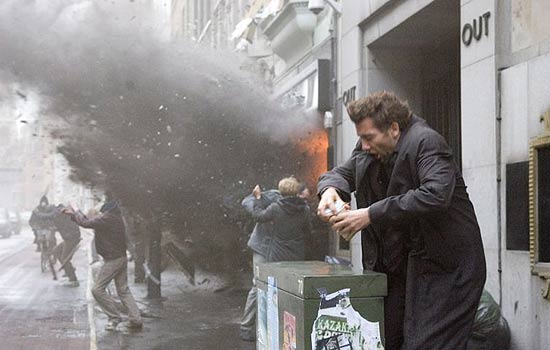
From when the character gets his coffee to going outside, the camera stays on him, and follows him in a continual shot. Then, when the explosion happens, the camera moves unsteadily towards it, when suddenly the screen changes to the title.
The man is the main focus throughout the opening scenes, as the camera follows him from all different angles such as behind him and straight in front of him. The camera also looks at the surrounding people, who are crying in the offices of his work at the screens showing the youngest person in the worlds death. The camera wants to how the mans point of view, and does so by following him, and then showing some of the views that he can see, such as the people throwing objects at the train when he is on it. He looks at the people, and so does the camera.
Does it conform to your expectations of a fictional film?
There is mystery, unanswered questions, violence, hostility, a futuristic element and a big explosion that may have resulted some deaths, so yes, it does.
Editing
What kind of editing do you recognize?
There isn’t lot of editing in the opening scenes as there aren’t many conversations between any characters. The camera does change between the man and other objects or people, such as the television in the coffee shop, the people crying in the office, and the television showing British propaganda on the train. The continuity shot at the start of the start shows that the director wants us to see the happenings from the point of view of the main character. Therefore, when the explosion happens, and when the people throw things at the train, the audience are just as shocked as he is.
As a result of the few edits there are, the pace is slowed down. This corresponds with the characters mood, he is tired, grumpy and unaffected by the death of the youngest guy on earth, and his day is going slowly, as if it is a routine he has.
Sound
There is no non diegetic sound until the explosion in which a ringing sound, probably representing the shock of the loud sound, but before that it is just the news reporter heard on the television and the man ordering his coffee. As he walks out before the explosion, the sound of motors is made clear to emphasize the pollution, as smoke and fuels billow out the back of them.
The ringing sound continues into the next scene where he is getting in to work which suggests that he is still shocked or stunned from the sudden explosion.
A sad music then overlaps the ringing sound which represents the sadness of the mans colleagues as they sit crying about the news of the youngest guy on the planets death.
Propaganda plays on the train, which plays the London landmark, Big Ben ringing its bell which is patriotic to Britain. A voice is then heard advertising the problem of illegal immigrants.
Mise en Scene
Everyone is wearing dark clothes and seems to be unhappy, as they walk around in the polluted, darkness of the futuristic London. The cars and buses are dirty, and the pavements have filled up rubbish bags piled up and there are no young people at all because of the situation.
 On the train, the windows are covered by a metal caging material which shows the danger of the outside world; this is highlighted when people throw things at the windows as it goes past. This does however keep him safe. The illegal immigrants are also in cages when he gets off the train, but they are in cages they would rather be out of, as they cry and beg the guarding policemen, who are armed with guns, to let them go.
 The situation of a futuristic London is created in which women cannot become pregnant, and people have come to accept that humanity is coming to an end. We know this as the news plays with the leading story being how the youngest guy died. London and the people is down trodden, with rubbish bins on the streets, hostile people acting violent, explosions happening, with people dying.
Genre
From the opening scene, the genre can be seen as an adventure, drama, mystery thriller, as it has all of these things. There is the sense of adventure in the futuristic London, an explosion and a mysterious feel, as the audience are unaware of the reasons for the collapse of the world. The drama is through the unsuspecting main character almost being hit by an explosion after coming out of the coffee shop, and then asking to leave work as he goes and meets a friend. It is mysterious as we don’t know anything about the main character who the camera follows, but due to being followed, he is somehow important to the plot.
Narrative
The story begins in the coffee shop with the news playing and people staring up at it, completely consumed by what is being said. It is made clear to the audience that what is on the news is important to us understanding the story, as it is loud and clear for us to hear. The protagonist comes into the shop and pushes past the people watching the news to buy a coffee. He is much less interested than the others, and after buying his coffee walks out. This immediately marks him out as different to the rest of the characters, and to confirm this, the camera follows him out of the shop and shows him altering his coffee with alcohol. This is followed by a loud explosion from the shop he had just exited, and he jumps, dropping his coffee as the camera moves unsteadily towards the explosion and an emerging screaming lady.
The opening then continues to the protagonist in his place of work, seemingly unaffected by what had just happened, as if it has happened before, and asks if he can leave. He lies about being deeply affected by the death of the youngest person on the planet and leaves on a train.
Audience

I think that, from the opening, the film could be enjoyed by any age. It would engage younger people as there is already explosions and deaths as well as mystery, but it would also attract older people as they can think more about the deeper meaning of the film and the future of the world.
Gender
Due to the explosion, deaths, sadness, gloominess of the opening, I would think it is a film that would be more popular with men than with women.
Financial Situation
I don’t see this factor as having any baring on whether they would want to see the film or not from seeing the opening few scenes.
From the clip, what is there to attract different audiences?
People who are enthusiastic about futuristic times and probably science fiction film lovers would be interested.
Values and Ideologies
I think the clip sends a message to the audience of this is what could happen in the future, and this is the result of what could happen in the future. It emphasizes the need for women in the world as people who keep the human race going, and without their ability to conceive, the world may come to an end.
Panic Room Opening
Camera Shot/Angle/Movement
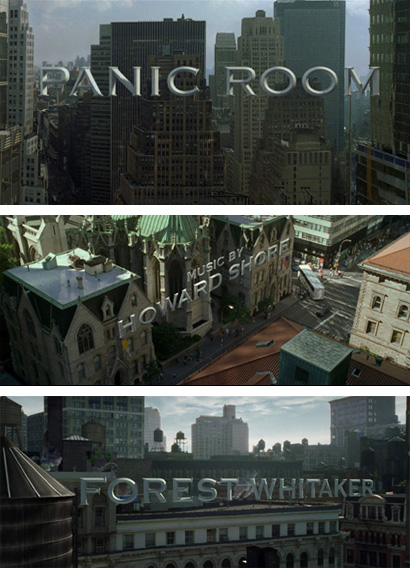
Most of the shots in Panic Room are mostly high angle shots, and pan across massive buildings in New York/California. They are aerial shots and also establishing shots, because it shows the audience where the film will take place.

The main three shots that are used throughout are establishing shots, wide shots and long shots.
The long shots and wide shots are used to give depth and width to the surroundings and to put emphasis on the size of the city that the movie is set in. There is a lot of camera movement such as when the camera pans around a building. This is done so that the audience can see the setting in a 3D motion.
Sound
The sound in Panic Room begins at a slow pace, but has a sinister tone to it. All there is being shown however, are the titles and the tops of large buildings, which makes the audience wonder why sinister music would be being played in what seems like an innocent atmosphere.
A few diegetic sounds are heard from police sirens and car horns, but this would suit the everyday happenings of a busy city and is nothing out of the ordinary.
 As the films title, Panic Room appears, the music gets louder and picks up pace, with a then ticking noise heard. This brings attention to the title and the following titles as well as the shots of buildings and the titles continues.
Editing
• The editing of ‘Panic Room’ consists of multiple shots and tracking. The cuts in each shot are sharp and continue throughout the sequence. There is a lot of simple editing used, the same cuts and panning are used in each shot. The editing speeds up as it gets closer to the end of the sequence, the shots become more precise and quick and there is no longer much panning used. The shots are still and cut into each other. This is a good effect used on the opening, it is simple but will still keep the viewer interested in the leading up of the film.
• There is a lot of use of transitions with the lettering that is used. The lettering fits in well with the scenery as it looks like it is a part of the background as it is constructed in a way so that it is parallel to the buildings
Mise en Scene
• The mise-en-scene of Panic Room is the same throughout the opening sequence. All the cuts consists of aerial shots of the city. We are shown different views and angles of what seems to be the same or similar buildings. The viewer is also shown ordinary pedestrians, cars and houses. It is as if the city is unaware of the camera and we are being shown what happens on a general basis.
Characters
• There are no characters shown until the end of the sequence, but we do see a glimpse of people in the street but they do not have a meaning or purpose to the sequence.
• They are shown in a dolly shot and are talking about a big house with many changes that they have made to it. They are also wearing smart clothes which suggests that they have a lot of money and are middle / upper class.
Location
• The opening sequence is located in an urban city which could be New York but the viewer is not completely sure.
• At the beginning of the sequence there is an aerial shot of skyscrapers and a river, this is why it could be associated with New York.
Narrative/Plot
• The plot is not identified in the opening sequence, the sequence keeps the viewer wondering what the film may be about and how the title relates to a city skyline. You don’t learn anything about the plot of the film and there is no narrative speech throughout.
• There is irony in the title and opening, as despite being called “Panic Room” which suggests a small claustrophobic room, the scene is in fact showing many big buildings in a very open area of the city.
Themes
• There can be very few themes taken from the opening titles, as there are no characters, and no dialogue, but from this, we can take the mystery and therefore thriller elements from it.
 Visual Style
• The visual style of Panic Room is very organized as the pace and speed of the opening builds up throughout the sequence, first starting slow and then slowly builds. Most of the visual shots are still and slow, this builds up tension as the music also starts off calm and slow. The visual style remains the same until the end of the sequence.
• The titles are shown in a three dimensional fashion, and are made as if to blend in with the buildings. They are the same light colour as the building but still stand out as the camera focuses on them
Genre
• From the opening, the film is most probably a thriller. There is mystery as we don’t know where we are, and there is tension thanks to the music that builds from the start.
• The title which includes the word “panic” suggests that it is a thriller with the panicking convention.
Se7en Opening
Camera Shot/Angle/Movement
The camera does not move very much, but changes from different angles on the antagonists hands and actions. All of the camera shots are either close ups of the mans hands, or extreme close ups. The audience are not shown the antagonists face, only his hands, which means that we are not supposed to know who he is - it is supposed to be a mystery. This creates tension and uncertainty as to what is actually going on.

The camera focuses on different pictures and words that the man has cut out from newspapers or photographs that he has taken. He seems to have written a lot as well , but about what, is unknown. Many images and words flash up on the screen, suggesting subliminal messages and mystery as to what they mean and why they are shown.
The camera never focuses on one particular object, and instead cuts to a variation of different objects that the antagonist is using.
There are some high angle shots, which do not represent authority or power as those shots may usually do, but instead are simply used to see the antagonists hands and hand movements from above to show his bandaged finger tips, as a result of him cutting them, and the documents that he has been writing.
Editing
In the opening scene of the antagonist in a dark, mysterious room, there is a wide use of jump cuts to show the discontinuous, jumpy movement of the pace of the film. It creates tension and mystery as it is obvious for the audience to see the changes because of how close the camera is to the hands of the antagonist.
These quick cuts are used throughout the opening sequence which make the audience feel uneasy by the fast pace of the strange, murderous man that the camera focuses on.
The editing used in this opening scene are rapid cuts, they go from one shot to another rapidly, and this builds the pace of the film adding suspense to the audience.
At the end of the opening there are lots of random words that pop up such as ‘Foot’ which are irrelevant to the movie. Also there is an image of an eye which is the last shot. This may be the ‘all seeing eye’ which suggests that the movie is revolved around religion;
Sound
The sound is mostly non diegetic, with a heavy, loud intimidating beat playing throughout the scene. The beat gathers pace, as does the overall noise of the non diegetic music which creates tension and an increasing feel of claustrophobia in the same, mysterious room with an antagonist who enjoys both cutting his own finger tips off, but also looking at horrific pictures of dead people.

during the end of the opening, the lyrics to the music say ‘...closer to God,’ while there is a shot of the character cutting out a part of a newspaper saying ‘God’. This gives away narrative clues to what the movie may be about
Mise en Scene
The mise en scene is of a dark, mysterious room, that is occupied by a very odd man; than antagonist. The room is darkly lit, with the only light shining on the focus points of what the antagonist is doing.
The antagonist is seen cutting papers up and writing or researching things in books, whilst also cutting his own finger tips off with a razor blade. The audience is then shown pictures of dead people that the antagonist is apparently looking at, which adds to the disturbing nature of the scene.
As a result, the antagonist has small bandages on his fingers to cover the injured fingers, and continues to look through files. He is also seen marking out a picture of a child by the eyes, and then, in another jump cut, it changes to the face being completely marked over in marker pen.
Characters

There is only one character shown in the opening sequence, and that is whom we are led to believe is the antagonist. The camera never shows his face, which adds to the mystery, but it is what we see from what he is doing with his hands that marks him out as a serial killer, or certainly someone with psychotic delusions.
He is shown cutting his finger tips off, perhaps to cover up any crimes that he may commit in the future, he has pictures of gruesomely dead people as well pictures of people whom he has scribbled on, especially over their eyes.
He could be seen as someone who is professionally linked with murders as he is doing lots of research and writing a lot whilst cutting up pictures of dead people, however, the darkness of the room and ambiguity of the character suggests that this is in fact an odd character.
Location
 The location is quite ambiguous. We are not shown a specific location, which adds to the mystery and thriller element of the film, but we know that it is the home, or workplace of the antagonist. We must also take the conclusion that it is quite secret, as the things he is looking at and doing would be deeply frowned upon to say the least
Narrative/Plot
There is no dialogue between any two character, mainly because there is only one character in it. We become aware of the basic narrative and plot from the actions of the antagonist. We come to the conclusion that he is a murderous villain with an evil mind.
There are a lot of subtle references to God and religion in this opening such as the ‘all seeing eye’ at the end, the lyrics to the background music say ‘...closer to God.’, and the cutting out of the word ‘God’ out of a newspaper.
Themes
The themes of the sequence are of mystery and horror. Mystery because the audience are unaware of the location, what the antagonist looks like, and the motive behind having these pictures of dead people.
It is horror because of the terrible pictures he has of people who are dead in horrible ways, such as the spike through the back of a mans head.
Visual Style
The visual style of the sequence is dark, gloomy, and mysterious. We are shown very few things that give us a lot of information, but simply vague clues as to what the antagonist is doing and what kind of person he is.
The title sequence shows the titles flash up on screen in a way that represents something that has been carved into the screen. The titles flash up on screen, and are joined, or followed by words that are not very clear and unable to be read with any real understanding without taking a second look.
It all creates the sense of unease and rising tension.
Genre
The genre of ‘Se7en’ thriller. The opening sequence emphasizes this because there are a lot of unanswered questions, and again, mystery as to what is going on.
Vertigo Opening
 The non digetic sound which is the soundtrack builds up tension it helps the audience to establish what kind of film `The girl with the dragon Tattoo ‘is. The type of music used is a convention of a traditional thriller which is very dramatic.
  The protagonist seems quite dominant and powerful we get this through the way she is introduce to the audience when the protagonist is on the motor bike. Also the clothing she is wearing and colour on her clothes shows that she is mysterious and does not meet the traditional convention of how a woman is presented in a tense thriller there is something dark and edgy about the protagonist. On the other hand another character that meets the convention of females in a tense thriller is the girl who I am guessing escapes from the antagonist who is kept anonymous; coming towards the end of the trailer the girl seems in distress, helpless and vulnerable.


 Drive Angry 3D is another Thriller film and also had a large percentage of male viewers over women viewers, and the majority of the audience are in the age bracket of 15-24.
Ratings

Vertigo Opening
Camera Shot/Angle/Movement
The clip starts with a close-up of a bar. The camera stays on the bar and suddenly a hand grabs it. second hand grabs it, and as a man climb up, the camera zooms out to reveal the man and the setting. This man then runs out of shot, but the camera stays put, and shows two other men climb up and chase in the same direction. There is then a long shot as the camera shows all three men running, and the camera pans to follow their movement.
Then there is a side on view of a roof top. The camera stays in the same place again to show all three men taking their turn at jumping on to the slanted roof and climbing up. As the third man jumps, there is a jump cut to a closer view of him then struggling as he slips down, trying to hold on.
The safe police officer turns back in a mid shot to see his friend struggling, and over his shoulder, the man they were chasing is seen getting away.
As the struggling man looks below to see what a big fall he would suffer if he were to let go, the camera zooms out to give the effect that his brain, in the panic is playing tricks on him.
There is a point of view shot as the safe man tells the struggling one to give him his hand so he can help him up, but as the man reaches down, he himself falls. There is another high angle point of view shot which shows the man falling to his death.
As people come to help the fallen man, the one holding on is showed in a close up which emphasizes his worry, anxiety, shock and struggle on his face.
Sound
The clip plays very fast paced non diegetic music. It is music that conveys tension and the edgy atmosphere. Gun shots can be heard as the policemen fire at the antagonist running away. This matches the conventions of a thriller. As the man looks down to see the big drop, the music gets louder and higher pitched as it highlights the shock and worry of the fall.
As the fallen man is confirmed dead, the music dies down as the action does, although the man is still stranded on the roof.
Editing
Fading effects from shot to shot, and from scene to scene.
Quick paced editing to create more tension and quick movement in the chase.
Mise en Scene
The setting is quite dark, and the characters, all three of them are wearing different uniforms. There is a policeman, and we know this because he is wearing a policeman's uniform. This tells the audience that he is a good guy, fighting for the law, which therefore suggests that the man he is chasing has done something against the law. The policeman has a gun which suggests he has the power, but in the end, he falls to his death, making the sequence even more unpredictable.
Character
There are three characters. The antagonist runs away from the two protagonists. One of the protagonists is a policeman and falls to his death when trying to help his fellow protagonist, and the man hanging off the roof survives but is very distressed after seeing his friend fall off the roof while he is left to hang there looking at the big drop.
Comparison Between Panic Room & Se7en
Comparison Between Panic Room & Se7en
Shot/Angle/Movement
The camera shots in Panic Room are quite long as all the shots are high angle shots of a city skyline. The camera also takes a while to cut between shots compared to the style of the camera in Seven which was very quick and constant between shots, as they are mostly extreme close up shots and the fast pace which emphasizes the actions that the character is doing.
Sound
The sound in Seven is very organized as in all the shots where the character is either stitching something or cutting paper etc. the sound also matches what the character is doing. But in Panic Room the sound is very different as it is the same all the way through the opening and builds in pace slowly.
Editing
There is not much editing in Panic Room as the shots are long and there is hardly any cuts between shots compared to Seven which cuts form shot to shot every few seconds.
Mise en scene
The mise en scene in Panic Room is very natural and not out of the ordinary with shots of a city skyline. The time of day featured in Panic Room suggests that something sinister is going to happen compared to Seven which doesn’t really have much lighting and has odd colours such as white, beige, grey and black. The colours and the surroundings of the character, which contains what seems to be photographs, books etc. suggests things like crime, blood and death.
Characters
The main characters in Panic Room are not quite clear until the end of the sequence when two people come into the shot, this is the start of the film. Although, in Seven we don’t see any characters faces but we can establish who the main one of the main characters are by seeing what they are doing during the sequence, we see that this person must be significant to the film. The differences are that we see some part of the character in Seven whereas in Panic Room we don’t see anyone until the end.
Locations
The location of Panic Room is clearly shown as the shots were of a city skyline, which could be New York but you are not really sure. Where in Se7en the location is not very clear or hinted, the audience can not really gather where the scene is located you are only aware that it is in a dark room and that the character is alone in that room.
Narrative/Plot
In Se7en there is no narrative speech or subtitles to help the audience to establish what it is about , but you can see that the character is putting something together that could be the focal point of the film. In Panic Room the plot of the film is not very clear but the shots of the buildings could make the audience relate the buildings to the film title.
Themes
The opening of Se7en contains various clues and hints as to what the theme of the film is, the shots contain clips of sharp objects and disturbing images. This could suggest that the film is about crime, mystery and murder. Compared to Se7en, Panic Room does not really contain any clues on the theme of the film but the audience could think that it mysterious mainly because of the music.
Visual Style
The visual style of Panic Room is very calm and has a slow pace and each shot is different views of buildings but Se7en has fast cutting shots and music that keeps the pace going. The music being played on both sequences goes well with the film title and images being shown.
Genre
Panic Room doesn’t consist of stereotypical conventions as each scene doesn’t highlight anything that suggests violence. Se7en on the other hand, has a lot of common conventions such as the razor blades and what looks to be blood in a certain part of the sequence, this suggests that the film is a thriller.
Extreme close up and close up are used in Se7en to signify the importance between objects and it helps the audience to identify and link the objects with certain conventions of a thriller whereas in the Panic room the director uses establishing shots and wide shots which helps to set the scene for the film but it leaves the audience questioning what the film is about.Both of the methods in terms of camera angle and movement are quite effective in similar ways and in different ways because both opening scenes leave the audience wanting more but the films do it using different types of camera shot which depict different types of meaning.
In the Panic room the soundtrack is completely different from the soundtrack of Se7en. The Se7en soundtrack is quire edgy and creates tension from the beginning of the opening scene we as an audience are hooked by the music straight away where as in the Panic room the soundtrack builds up slowly then eventually you hear ticking noise and the soundtrack because more tense and dramatic.
The editing of Panic room and Se7en are quite similar because the jump cut is present in both opening scene jump cut is used to quicken the pace of both opening sequences. But what makes the editing a bit different in Se7en is the editor uses cross cutting in to emphasize the importance of the hands.
In Se7en we as an audience are not real able to identify exactly what is the location of the antagonist but we are left to imagine where the location is like a confined place where the antagonist can not be seen. Whereas in contrast ,in Panic room we are introduced to the location at the beginning of the opening extract this makes the audience to set the scene and understand the society in the film is set in.
In Se7en the perception of the character is very disorientated because we do not hear or see the antagonist but we do have an idea of what kind of person the character is whereas in Panic room we are left with no idea who the main character is or even what the film but the only character we do see is a woman walking with her p.a behind her the woman seem powerful and dominant through the way her p.a is positioned.
Title Sequence:
Children of Men
This is the first title that appears in the opening of Children of Men. “Universal Pictures” are the company that own the film and have been put as it says that it “presents” the following sequence. They are the producers.
The opening then does not continue t
The title of the film comes up late on which is unusual, and after that flash on the screen of the title, there are no more titles appearing.
Title Sequence:
Se7en
In the antithesis to Children of Men, the Se7en opening shows all of the usual format of titles that will be shown. The first that is shown is the film company: New Line Cinema, and “presents”.
Next, the name of the director is shown. The titles are in a flickering, childish like written way on the screen.
The main actors from the cast are then
Morgan Freeman is then put up after that and it flickers and mirrors so that it is read backwards.
The title, Se7en is then flashed upon the screen very quickly and then goes to a smaller font, staying on the screen for a couple of cuts to show the importance of this particular credit title as it is the name of the film.
Next to be shown is the supporting cast who play smaller roles and do not play as substantial a role as the previous main characters. There are a lot of supporting actors and actresses, and their names flash on the screen for a little while before the cast is introduced.
The rest of the cast is introduced which is who the music is made by, who the costumes are designed by, who the film is edited by and who the production is designed b
The next titles are the people who produced the film, and it ends with the director of the film which is shown again, as it had already been shown at the beginning of the opening.
Title Sequence:
Panic Room
The opening of the Panic Room
The Production Company and Distribution company for Panic room is Columbia Pictures and Hofflun/Polone. They are introduced right at the start of the clip just before the opening begins to play. Columbia Pictures is the first thing you see on the screen and then when the title sequence begins we see the production company Hofflun/Polone. The purpose the presentation of the production companies could be to one of two effects; to make audience aware of the fact the film is about to start, so to begin to quieten down and also to advertise the fact that they are the production and distribution companies and can not be mistaken for anything other than what it is.
The information that was included in the title sequence is:
The Production Company
Distribution Company
Scene in which the film is set or will start in
Important Actors/Actresses
Title
editors/directors,directors, producers.
Throughout the opening clip we are shown a discrete title sequence which is in silver block capitals, which could represent sterile environment or cold emotions. The fact that the title sequence is discrete allows for the audience to see the scene which is being set, which appears to be in New York City. You can see this by the large buildings, the yellow taxi's, the busy city below and the empire state building.
There is a lot of non diagetic sound during the the opening title sequence which is majority Orchestral sound, with violins and other instruments being played which could seen to represent a heartbeat getting louder and at a faster pace. This create a sense of worry and anticipation for what may be to come in the film.
The Girl with the Dragon Tattoo Opening
At the beginning of the extract the camera tracks the protagonist this makes the viewer recognize the main character it introduces the audience to the main character also while tracking is used to follow the protagonist the protagonist is shot from a low angle which makes the antagonist seem dominant and powerful. An extreme close up used on the picture of the girl`s eyes this is significant because it helps the audience to establish what goes on in the film also a picture of someone and which in the case of the film is a girl is a convention of a thriller because it is a symbol of kidnapping or even death like for example when see people in the newspaper we generally assume that the person has been kidnapped so the use of the convention helps to build up the story. Later on in the trailer a close up is used to show the girl who was in the pictures face to show how distress and helpless the girl is also the girl has blood on her face which is a convention of a thriller and this helps the audience to link the type of genre the film is to a thriller. A close up used when the person who is riding the motorbike takes off her helmet us as an audience is shocked by this because it is a woman and this does not fit in with the convention of men being the protagonist, the woman breaks out of the stereotype that woman are weak and helpless and the protagonist who is a woman persona is strengthened by the fact that she is riding a motor bike it makes her seem tough and strong. A wide shot is used to show the dead persons leg and the persons surroundings by only show the dead persons feet creates tension it teases the viewer it makes the audience want to know who has died and how they have died also if it’s a murder it makes the murderer seem anonymous which is a convention of a serial killer.
 The non digetic sound which is the soundtrack builds up tension it helps the audience to establish what kind of film `The girl with the dragon Tattoo ‘is. The type of music used is a convention of a traditional thriller which is very dramatic.
 A lot of jump cuts are used in the trailer it quickens the pace of the trailer and as an audience it’s very difficult to understand what is actually happening it teases the audience want to know more about the film and as a theatrical trailer it is very sufficient it does its job it leaves the audience disorientated and confused.
The antagonist is wearing a leaver jacket the jacket symbols that the protagonist is strong; tough the trailer mostly exhibits close up so this makes the location difficult to identify this creates tension and it’s also a convention of a tense thriller. The lighting of trailer is quite natural the director does this to make the film look more realistic.
 The protagonist seems quite dominant and powerful we get this through the way she is introduce to the audience when the protagonist is on the motor bike. Also the clothing she is wearing and colour on her clothes shows that she is mysterious and does not meet the traditional convention of how a woman is presented in a tense thriller there is something dark and edgy about the protagonist. On the other hand another character that meets the convention of females in a tense thriller is the girl who I am guessing escapes from the antagonist who is kept anonymous; coming towards the end of the trailer the girl seems in distress, helpless and vulnerable.
 The narrative or plot is that a girl is killed and the protagonist takes on the job of solving the murder but by taking on the job the protagonist is putting herself in danger. Themes represented in the trailer is death because we see a dead body which is a convention of a thriller also romance/love is a theme present in the film because we see the protagonist having sexual relation with another person in the trailer.
Preliminary Task
by
Dan
Darren
Int. scene - description
Dan walks down the corridor with purpose and intent, he is looking angry. He approaches the door and opens it, walking in, and sits down opposite Darren.
Darren is staring straight ahead of him, as Dan sits. Jack places a folder on the desk.
DAN
Wheres the body?!
Darren slams his fist onto the desk.
DARREN
I told you, and I will tell you again, I was at home playing scrabble! My mum can testify that fact!
DAN
I don’t but it.
Pearl and Dean film research

The reason why we chose Hot Fuzz because it is a thriller and also a comedy film.
We like the cuts in the film which the director as he uses a variety of
cuts especially jump cuts to create suspense.

The reason why we chose Dark knight because it is a thriller and also it has the typical convention of a thriller.

The reason why we chose unknown because it has a similar plot to are film:
Dr. Martin Harris (Liam Neeson) awakens after a car accident in Berlin to discover that his wife (January Jones) suddenly doesn't recognize him and another man (Aidan Quinn) has assumed his identity. Ignored by disbelieving authorities and hunted by mysterious assassins, he finds himself alone, tired, and on the run. Aided byan unlikely ally (Diane Kruger), Martin plunges headlong into a deadly mystery that will force him to question his sanity, his identity, and just how far he is willing to go to uncover the truth.
 Drive Angry 3D is another Thriller film and also had a large percentage of male viewers over women viewers, and the majority of the audience are in the age bracket of 15-24.
Ratings
12
Recommended for 12 years and older. Nobody younger than 12 may rent or buy a '12' rated video. (Until 31 August 2002, this mandatory certificate used to apply to cinema exhibitions as well).
15
Suitable only for 15 years and older. Nobody younger than 15 may see a '15' film in a cinema. Nobody younger than 15 may rent or buy a '15' rated video (these films may contain offensive or emotionally harrowing scenes or strong language and violence). Examples include The Shawshank Redemption and The Girl Next Door.
18
Suitable only for adults. Nobody younger than 18 may see an '18' film in a cinema. Nobody younger than 18 may rent or buy an '18' rated video (These films may contain extreme gore/violence and/or sexually explicit content). Examples include A
Clockwork Orange and Inglourious Basterds.
Clockwork Orange and Inglourious Basterds.
Research into the Genre: Thriller
A genuine, standalone thriller is a film that provide thrills and keeps the audience cliff-hanging at the "edge of their seats" as the plot builds towards a climax. The tension usually arises when the character(s) is placed in a menacing situation, a mystery, or a trap from which escaping seems impossible. Life is threatened, usually because the principal character is unsuspectingly or unknowingly involved in a dangerous or potentially deadly situation.
Thrillers mostly take place in ordinary suburbs/cities. Though sometimes, they may take place wholly or partly in exotic settings such as foreign cities, deserts, polar regions, or the high seas. The heroes in most thrillers are frequently ordinary citizens unaccustomed to danger. However, more common in crime thrillers, they may also be "hard men" accustomed to danger, like police officers and detectives. While such heroes have traditionally been men, women lead characters have become increasingly common.
Thrillers often overlap with mystery stories but are distinguished by the structure of their plots. In a thriller, the hero must thwart the plans of an enemy rather than uncover a crime that has already happened. While a murder mystery would be spoiled by a premature disclosure of the murderer's identity, in a thriller the identity of a murderer or other villain is typically known all along. Thrillers also occur on a much grander scale: the crimes that must be prevented are serial or mass murder, terrorism, assassination, or the overthrow of governments. Jeopardy and violent confrontations are standard plot elements. While a mystery climaxes when the mystery is solved, a thriller climaxes when the hero finally defeats the villain, saving his own life and often the lives of others. In thrillers influenced by film noir and tragedy, the compromised hero is often killed in the process.
Notable Thriller Directors:
David Fincher - Se7en and Panic Room
&
